Is It Safe to Walk a Dog After Dark? What Owners Should Check First
You look at the clock, realize the day got away from you, and now the walk has to happen after sunset. Your dog still needs exercise. The route is familiar. It feels manageable. But is it safe to walk dog after dark? Yes, often it is, but only if a few things are working in your favor: visibility, route choice, traffic awareness, and gear that helps your dog stand out before a car gets close.
A normal evening walk can turn risky for small reasons. The street is dimmer than you remembered. Your black dog blends into the pavement. A cyclist comes fast out of nowhere. Drivers turning into side streets are looking for headlights, not a low-moving dog near the curb. You do not need a giant checklist for every night walk, but you do need a system that catches the obvious risks before you are halfway down the block.

This article is about those first checks. Not theory. The practical stuff that makes an after-dark walk feel calm instead of tense.
Visibility Changes Everything After Sunset
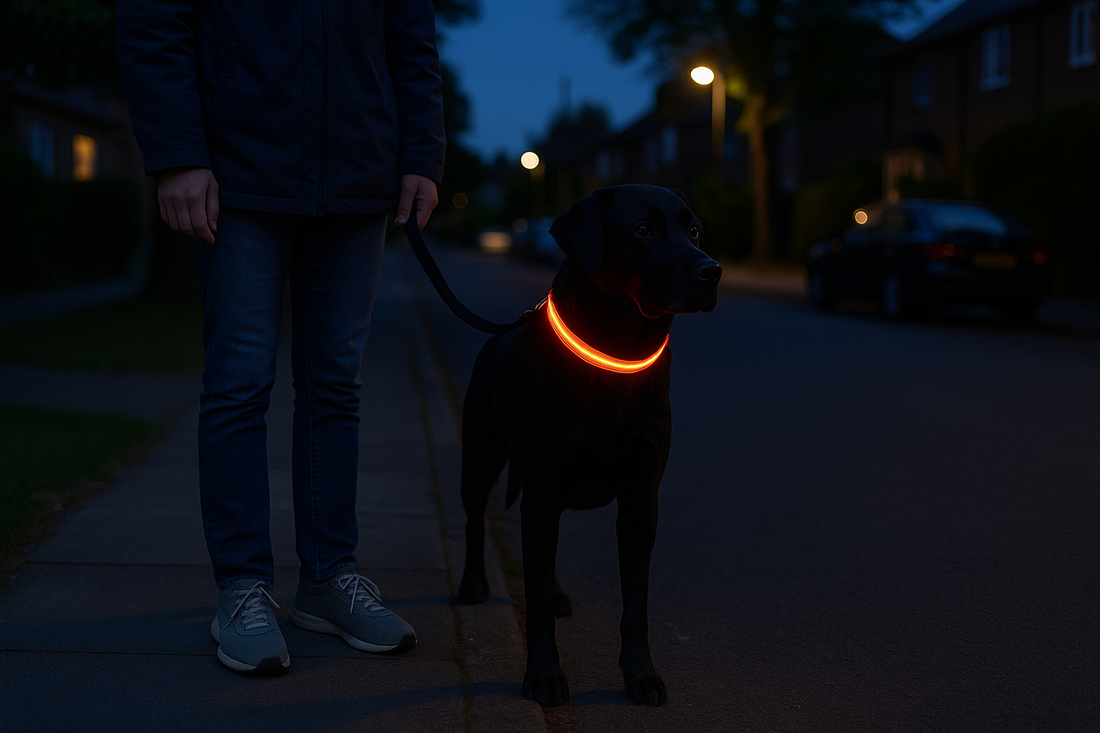
The biggest shift after dark is simple: people see your dog later. A golden retriever under a streetlight is still easier to spot than a black lab on a dim residential corner, but both are harder to notice than they are during the day. Reaction time shrinks fast in low light.
This is where visible gear stops being optional and starts being practical. A bright LED dog collar for after-dark walks helps drivers, cyclists, runners, and even other dog owners notice movement sooner. And sooner is what matters. A few extra seconds can be the difference between a calm pass and a messy near miss.
If your routine includes regular night walks, the night walk essentials collection is the most relevant collection for this topic because it is built around low-light visibility first.
Our earlier article on why every dog needs a LED collar for night walks covers the visibility side in more detail, but the short version is easy: if your dog is hard to see, the walk is harder to control.
Your Route Matters More at Night Than During the Day
A route that feels boring in daylight can be the smartest option after dark. Familiar sidewalks, better street lighting, slower traffic, and fewer blind driveways all matter more once visibility drops.
Some streets look quiet but are actually worse at night. Long stretches with parked cars, shadowy corners, narrow sidewalks, and lots of driveway cutouts are where surprises happen. A dog that zigzags, sniffs, or suddenly pauses near the curb is much easier to manage on a route with space and light.
If you are walking a reactive dog, a puppy still learning leash habits, or a strong dog that lunges at movement, simplify the route even more. Night is not the best time to test a new shortcut.
What to Check Before You Leave
- Check whether your dog is actually visible from a distance, not just wearing a collar.
- Look at the route and decide whether it has enough light and enough room to move away from traffic.
- Make sure the leash, clip, and collar are secure before the door opens.
- Think about timing. A 9 p.m. walk in a quiet neighborhood is different from a 6:30 p.m. rush-hour sidewalk near traffic.
- If the walk may run long, carry water in a compact setup instead of hoping you will not need it.
For longer evening outings, a dog water bottle and food container earns its place because dogs can still get thirsty on cool night walks, especially after warm days or active routes.
Some Dogs Need More Conservative Night Rules
Not every dog handles after-dark walks the same way. A calm senior cavalier on a quiet loop is one thing. A young husky that pulls toward every sound is another.
Small dogs can be harder for drivers to see at all. Black-coated dogs disappear quickly in low contrast. Flat-faced breeds may not be the biggest visibility problem, but they can still struggle on warm nights that feel cooler to you than they do to them.
And some dogs are just more uncertain in the dark. They stare longer, stop more, react to shadows, or get jumpy around moving lights. Those dogs do better with shorter routes, stronger routine, and gear that helps both of you feel more in control.
Where Night Walks Usually Go Wrong
Most problems do not start with dramatic danger. They start with small assumptions.
You assume the street is bright enough because it usually feels fine from the car. You assume the collar is visible because it looked bright indoors. You assume the dog will walk the same way at 9 p.m. as at 4 p.m. And then a cyclist comes fast behind you, or a car turns without noticing the dog at the edge of the road.
Evening walking gets easier when you remove those assumptions. Visible dog. Known route. Secure gear. Realistic timing. Those basics solve more problems than complicated advice ever will.
If you want more low-light setup options, the safety and walking collection is the other useful collection for this cluster.
Practical Safety Tips for After-Dark Walks
- Keep the dog on the side farthest from traffic when the sidewalk is narrow.
- Use lit crossings instead of quick diagonal shortcuts.
- Shorten the leash near driveways, corners, and parked cars.
- Do not count on streetlights alone if your dog has a dark coat or low profile.
- If the dog seems uneasy, shorten the walk rather than forcing the full route.
- Make night walks more predictable, not more adventurous.
A predictable walk is usually the safer walk.

FAQ
Is it safe to walk dog after dark in a quiet neighborhood?
Usually yes, if the dog is visible, the route has decent lighting, and you are not relying on traffic to notice you at the last second. Quiet does not always mean low risk if visibility is poor.
How visible should my dog be at night?
Your dog should be easy to spot from a distance, not only visible when someone is already close. If a driver or cyclist would only notice the dog near the curb at the last moment, visibility is not good enough.
Do I need a light-up collar if there are streetlights?
Often yes. Streetlights create patches of light and shadow, and many dogs disappear between them, especially black dogs, small dogs, and dogs walking beside parked cars.
Are night walks riskier for black dogs?
Yes, usually. Dark coats blend into roads, hedges, and shadows much faster than people realize. Extra visibility gear matters more for them.
What is the first thing to check before an evening dog walk?
Check whether your dog is clearly visible in low light. Everything else gets harder to manage if other people cannot see the dog early enough.
Before tonight’s walk, check your dog’s visibility from the curb, not just from your hallway mirror. See how a LED dog collar performs on real evening routes →