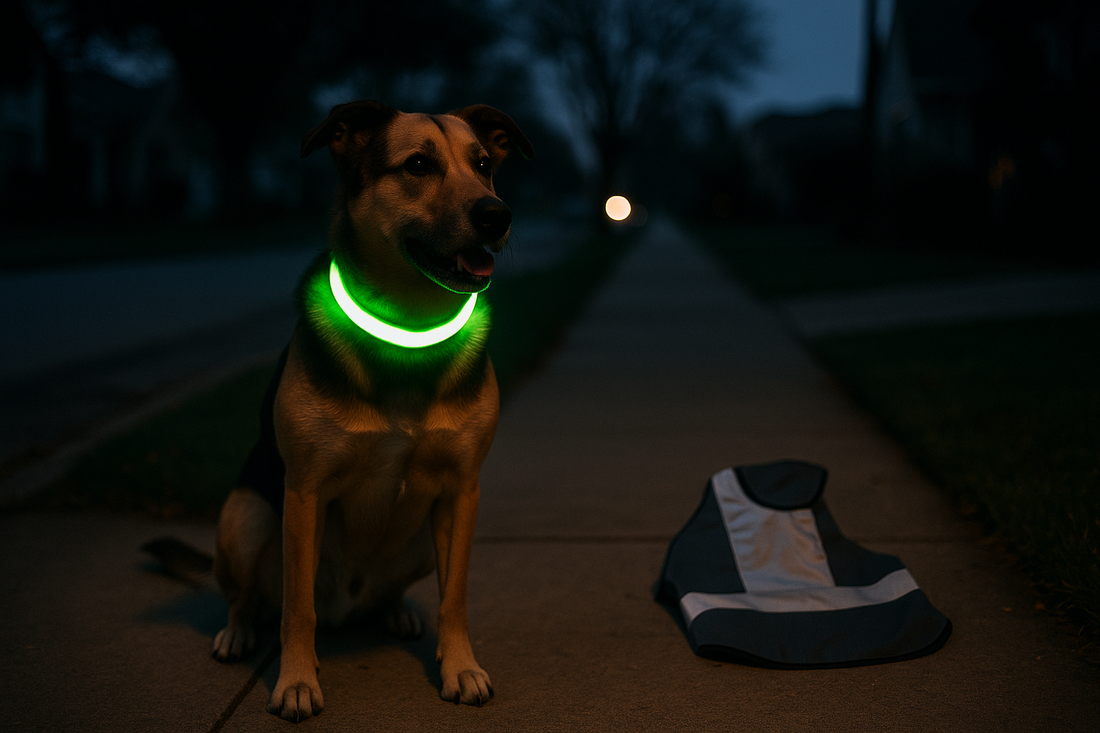
LED Collar vs Reflective Vest for Night Dog Walks
You are standing by the door, leash in hand, trying to decide what actually helps more on an evening walk: a glowing collar or a reflective vest. And the answer is not as generic as people make it sound. The led collar vs reflective vest dog question matters because both products aim to solve the same problem, but they do it in very different ways. One creates its own light. The other waits for outside light to hit it.
That difference gets real fast after dark. On a dim residential street, a black lab in a reflective vest may still be hard to notice until headlights reach the vest at the right angle. A dog wearing a bright LED collar is usually easier to spot earlier because the collar is visible before that car gets close. But reflective gear still has a place, especially in certain walking conditions. So if you are deciding what belongs in your actual routine, here is how the tradeoff really looks.

They Solve Visibility in Two Different Ways
An LED collar emits light on its own. A reflective vest does not. It depends on light from a car, bike, flashlight, or streetlamp bouncing back.
This sounds like a small detail until you walk in a poorly lit area. If your dog is moving near driveways, parked cars, hedges, or darker pavement, being visible before something shines directly on them is a real advantage. A glowing collar can outline the dog’s location continuously. Reflective gear is more conditional.
This is why the first question is not which one is safer. It is what kind of darkness you are walking in. A city sidewalk with regular headlights is different from a dim suburban loop or a village road with long stretches of shadow.
How an LED Collar Works in Real Life
A good LED dog collar for night walks is easy to understand once you use one outside instead of indoors. Indoors, almost anything looks bright. Outside, what matters is whether the dog stays easy to track while moving.
On an evening route with patchy lighting, an LED collar keeps your dog visible across darker gaps. That is useful if your dog pulls ahead, sniffs near the curb, or changes pace often. A small terrier can disappear visually much faster than people expect. A black German shepherd can do the same once the streetlight is behind them instead of above them.
You also get a clearer sense of where the dog is positioned relative to traffic. That matters at corners, driveways, crossings, and apartment parking lots where people are looking for motion but not necessarily expecting a dog at knee height.
If you want gear built specifically around this kind of use case, the night walk essentials collection is the most relevant collection for this topic.
Where a Reflective Vest Can Help
A reflective vest is not useless. It just works best in more specific conditions.
If you walk on roads where cars pass regularly and headlights are likely to hit the dog directly, reflective material can light up strongly. Vests also cover more body area than a collar, which can help if your dog is larger or if you want more surface area catching light from different angles.
They can be especially helpful for dogs on straighter roadside routes where traffic is the main concern and the dog is not weaving in and out of shade. A reflective vest can also help in early dawn light, when it is not fully dark but still dim enough that movement is harder to pick up quickly.
The tradeoff is that reflective gear does nothing in total darkness unless light hits it. So if you walk in areas with uneven lighting, the vest is often more of a supplement than a full solution.
Which One Is Better for Different Dogs?
Dog size, coat, and behavior all change the answer.
For small dogs
LED collars usually make more sense because small dogs vanish visually faster at night. A little dachshund or Yorkie can be hard to spot behind parked cars or low shrubs. A glowing collar helps fix that quickly.
For dark-coated dogs
Again, LED usually wins. Black labs, black poodles, and dark brindle dogs blend into low-light backgrounds in a way many owners underestimate until they see it from across the street.
For thick-coated or fluffy dogs
A vest may give you more visible surface area, but only if it fits well and does not shift. An LED collar can still work well, though very dense fur may partly hide it if the fit is wrong.
For dogs that hate extra gear
This is where collars have a practical edge. Many dogs tolerate a collar better than a body garment, especially if they already dislike harnesses, coats, or anything pulling over the shoulders.
If low-light walks are already part of your schedule, our earlier guide on what to check before walking a dog after dark fits naturally with this comparison.
What Works Better for Busy Daily Routines
You can own the better visibility product on paper and still not use it if it is annoying. That is where daily routine matters.
An LED collar is usually faster to grab, clip on, and use without negotiation. A reflective vest often takes more adjustment, especially on wiggly dogs or dogs with thick fur. If your evening walk happens after a long workday, the thing you can put on in five seconds is usually the thing that gets used consistently.
And consistency matters more than theory. A slightly less perfect product used every night beats the ideal product sitting on a hook because nobody wants to wrestle a dog into it.
If your route is longer and your dog needs a break during night walks, a dog water bottle and food container is still useful to keep on hand, especially after warm days when the pavement holds heat into the evening.
Practical Tips Before You Choose
- If your streets are dim and unevenly lit, choose an LED collar first.
- If most of your risk comes from passing headlights on roadside walks, a reflective vest can still help.
- If your dog hates wearing body gear, do not force a vest when a collar will actually get used.
- If your dog is black, small, or fast-moving, lean toward active light instead of passive reflection.
- If you want the most visible setup possible, many owners eventually layer both rather than treating it as an all-or-nothing decision.

FAQ
Is an LED collar better than a reflective vest for night dog walks?
In many low-light walking situations, yes. An LED collar creates its own light, so your dog can be seen earlier instead of waiting for headlights or another light source.
When is a reflective vest better for a dog?
A reflective vest can work well on routes with steady traffic and consistent headlights, especially when you want more reflective surface area on a larger dog.
Should a black dog wear an LED collar or reflective vest?
An LED collar is usually the stronger first choice because black dogs disappear visually faster in low light and benefit from gear that stays visible continuously.
Can I use both an LED collar and a reflective vest together?
Yes. Many people do that for maximum visibility, especially on darker roads, winter walks, or routes with mixed traffic and poor lighting.
What is easier for everyday use: LED collar or reflective vest?
For most owners, the LED collar is easier to use daily because it is quicker to put on and less fussy than a vest.
If you want visibility that works before headlights get close, check how a dog LED collar performs on your actual evening route →