How to Prevent Mealtime Fights in Multi-Dog Homes
You put two bowls down, and the whole kitchen changes. One dog eats too fast. The other hovers. Someone stiffens, someone gulps, someone swings toward the other bowl, and suddenly dinner feels more like crowd control than a routine. If you are trying to prevent mealtime fights in a multi dog home, the fix is usually not one big correction. It is better structure, more distance, and feeding tools that lower tension before it spikes.
Food competition shows up fast in shared households. A beagle that is polite with humans may still rush another dog’s bowl. A rescue dog with food insecurity may panic the moment another dog gets too close. A young lab can create chaos just by finishing first and wandering over. You do not need constant drama for this to become a problem. A few tense meals in a row are enough to turn feeding time into something both dogs start anticipating badly.

Why Dogs Fight Around Food Even in Otherwise Calm Homes
Most multi-dog mealtime tension is not random aggression. It is pressure. Proximity, speed, competition, and predictability all pile up at once.
One dog may guard space. Another may inhale food and then circle for leftovers. A smaller dog may panic because a bigger dog finishes first every single meal. Even dogs that coexist well on the couch can get sharp around food because the setup itself is creating conflict.
If one of your dogs already gulps meals, our earlier article on how to stop fast eating in dogs is useful background because fast eating often triggers the whole chain reaction in shared homes.
Distance Fixes More Than Verbal Corrections
Owners often try to talk their way through a setup problem. Stay. Leave it. Back up. Wait. Those cues help, but distance usually helps more.
Feed dogs far enough apart that neither feels watched or crowded. In some homes that means opposite sides of the kitchen. In others it means separate rooms with doors, gates, or barriers. If one dog keeps glancing up at the other’s bowl, you probably do not have enough space yet.
Dogs eat faster and more tensely when they think another dog can get to their food. More distance usually lowers that pressure immediately. It also gives you cleaner information about whether the issue is competition, guarding, or just chaotic routine.
Slow the Fast Dog Down Before It Becomes the Other Dog’s Problem
In a lot of homes, one dog is not starting fights exactly. They are creating the conditions for one. The usual pattern is simple: one dog finishes in 40 seconds, walks over to the slower dog, and now the slower dog has to defend space mid-meal.
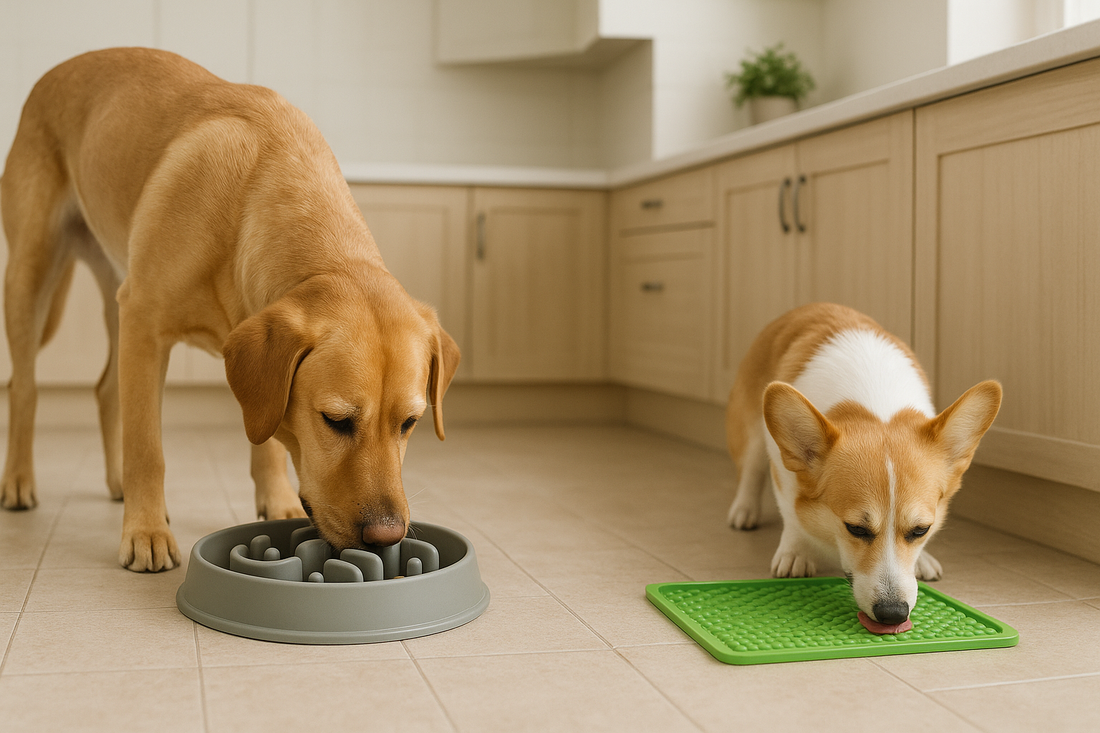
A dog slow feeder bowl is useful here because it buys you time. Not abstract enrichment time. Real practical time. The fast dog spends longer working through their own food instead of finishing first and turning dinner into a surveillance mission.
If your household has one very fast eater and one more cautious dog, slowing the first dog down often changes the entire emotional tone of the meal.
The feeding and health collection is the most relevant collection for this topic because this is really a feeding-structure problem before it becomes a behavior problem.
Use Lick Mats to Separate Pressure and Create Focus
Lick mats help in a different way. They do not replace the meal bowl in every situation, but they can create calmer, more stationary food engagement when one dog needs a softer setup.
A dog lick mat slow feeder works well for dogs who get overstimulated around bowl routines or who do better when the pace is naturally slower. Some owners use one bowl plus one lick mat in separate zones when dogs have very different feeding styles.
This also helps if one dog is not starting fights but shuts down when the other dog is nearby. A lick mat can hold that dog’s focus better and reduce frantic scanning during the meal.
If you want the broader comparison between tools, our earlier article on lick mat vs slow feeder bowl helps explain when each one fits best.
Practical Steps for the Next 7 Meals
- Feed the dogs in separate zones, not shoulder to shoulder.
- Do not let the faster dog roam once their bowl is empty. Redirect or gate them immediately.
- Use a slow feeder for the dog that finishes first.
- Use a lick mat for the dog that gets stressed by bowl pressure or competition.
- Pick the same feeding spots every day so the routine becomes predictable.
- Lift bowls when the meal is over instead of leaving leftovers out as a social test.
What Makes Mealtime Worse Fast
A few habits almost always increase tension.
Putting bowls too close together. Letting one dog hover over the other. Feeding high-value toppers in a shared space without structure. Calling both dogs into a tight feeding area and expecting them to sort it out politely. That works in some homes until it suddenly does not.
The other trap is assuming no growling means no problem. Many dogs give quieter signs first: eating faster, stiffening, guarding with body position, or glancing up every few seconds. Those are early warnings, not quirks.
When You Need More Than Better Setup
If there has already been a serious bite, repeated guarding, or escalating tension despite separation, the setup alone may not be enough. At that point, bringing in a qualified trainer is smarter than hoping the dogs will self-correct over time.
But in a lot of households, meals improve fast once the routine stops creating pressure. More space. Slower eating. Clear feeding zones. Less wandering after one dog finishes. Those changes are not flashy, but they work.

FAQ
Should dogs in the same home always eat in separate rooms?
Not always, but many multi-dog homes do better with more separation than owners initially expect, especially if one dog finishes much faster than the other.
Can a slow feeder help prevent fights between dogs?
Yes, especially if one dog eats fast and then moves toward the other dog’s food. Slowing that dog down often reduces the whole chain reaction.
When is a lick mat better than a bowl in a multi-dog home?
A lick mat can help when a dog gets overstimulated by regular bowl feeding or needs a calmer, more focused feeding setup away from the other dog.
What is the first warning sign of mealtime tension?
Often it is not fighting. It is stiff body language, rapid eating, hovering, or repeated checking of the other dog’s bowl.
Should I let dogs “work it out” at mealtime?
No. Food conflict usually gets safer when you manage the environment clearly instead of waiting to see how far the dogs will push it.
If mealtime feels tense, change the setup before the next bowl hits the floor. See how a dog slow feeder bowl or dog lick mat slow feeder fits your feeding routine before the next meal →