How to Keep Track of a Black Dog at Night
A black dog can vanish fast after sunset. Not in a dramatic movie way. In a very normal real-life way. One second your dog is at the edge of the sidewalk, and the next second dark fur, dark pavement, and low light all blur together. If you are trying to figure out how to keep track of black dog at night, the main issue is contrast. Dark coats absorb the little light that is available, so your dog disappears sooner than a cream spaniel or a white doodle would in the exact same place.
This is one of those problems people underestimate until they actually live with it. A black Lab near parked cars. A black poodle mix on a shadowy path. A small black terrier cutting across the edge of a dim yard. You are not imagining it. Tracking a dark-coated dog at night really is harder, and the solution is to make your dog stand out before you need to panic and look for movement.

Dark Fur Changes Night Visibility More Than Owners Expect
Black and very dark brown coats do not reflect much light in low-visibility conditions. That sounds obvious, but the practical effect is bigger than many people expect. Under streetlights, your dog may look visible enough from one angle and almost disappear from another. On wet roads, it gets worse. Near hedges, parked cars, and dark fences, it gets worse again.
This matters on ordinary routes. You do not need to be hiking in the woods for this to be a problem. A quiet suburban sidewalk with patchy lighting is enough. So the real goal is not just seeing the dog “somewhat.” The goal is making your dog easy to pick up instantly, even when your attention shifts for a second.
Use Light That Outlines the Dog, Not Just the Area
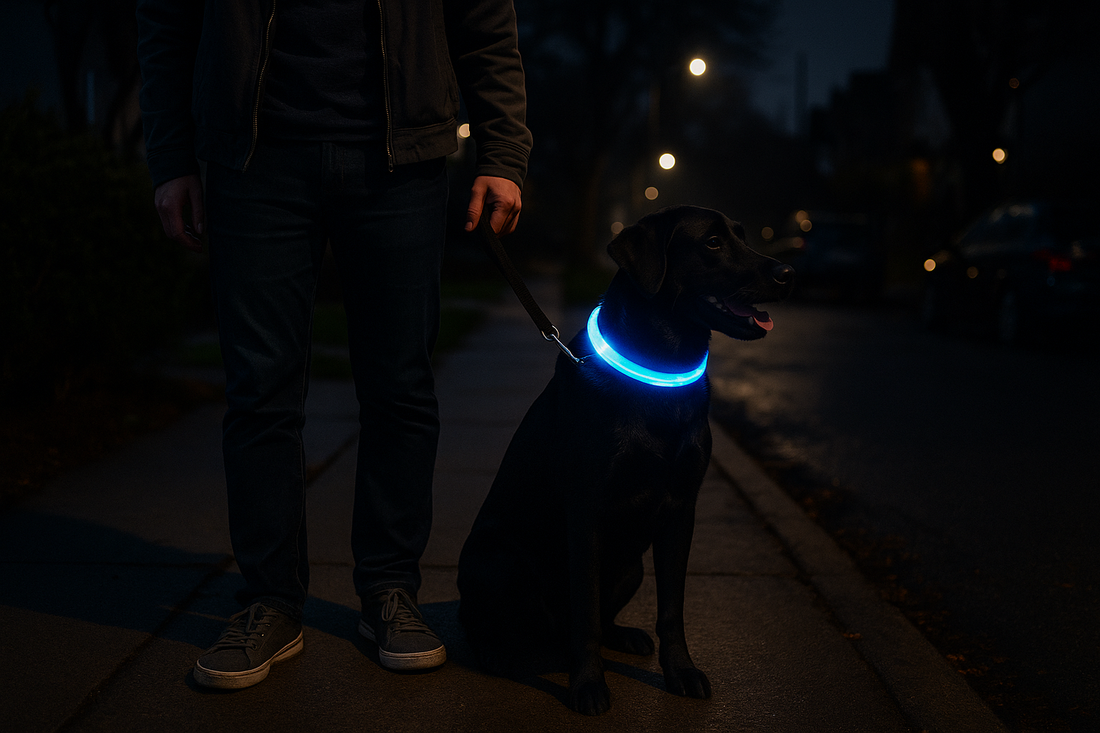
This is where a bright LED dog collar for black dogs at night makes a practical difference. It creates visible outline and movement around the dog instead of relying on the environment to do the work.
A black collar on a black dog is almost useless after dark. A glowing collar changes the whole picture. You are no longer trying to read body shape out of shadow. You are tracking a visible marker that moves with the dog. That is especially useful if your dog drifts toward the curb, pauses by parked cars, or likes to sniff the darkest part of the route.
If night visibility is already part of your regular routine, the night walk essentials collection is the right collection for this use case.
Where Black Dogs Usually Disappear First
Some places make the problem much worse.
Parked cars
A black dog passing between or beside dark vehicles can vanish in one second if the lighting is uneven.
Wet pavement
Rain and road shine flatten contrast, especially under mixed streetlight and headlight glare.
Hedges and tree lines
Dark greenery swallows dark coats fast. You may still know where the dog is generally, but not precisely.
Unlit corners and driveways
These are the spots where you most want exact position, and often the spots where the dog is hardest to see.
Our earlier article on what to check before walking a dog after dark pairs well with this one because route quality matters almost as much as visibility gear when the dog’s coat is dark.
Tracking Gets Easier When the Route Gets Simpler
Owners often focus only on gear. Gear matters, but route choice matters too. If your black dog is hard to track at night, pick routes with cleaner light, fewer blind driveways, and less visual clutter. You do not need a scenic route. You need one where your dog stays easy to locate with one glance.
Shorter leash handling also helps. On dim roads or around moving traffic, a little less roaming space makes it easier to keep the dog in your visual field. This is not about reducing freedom forever. It is about reducing guesswork where visibility is weakest.
Practical Ways to Keep Better Visual Contact
- Use active light, not just reflective details.
- Keep the dog on the side away from traffic when sidewalks are narrow.
- Avoid long dark stretches with parked cars if you have a better route available.
- Check how visible the collar is from 20 to 30 meters away, not just at arm’s length.
- Shorten the leash near driveways, corners, and wet glossy roads.
- If your dog is small and black, assume you need more visibility than you think.
What Owners Usually Get Wrong
The first mistake is assuming their own eyes will adjust enough. Sometimes they do. Sometimes they do not. A dog that is “technically visible” is still too hard to track if you need to stare at the shadows to confirm where they are.
The second mistake is relying on streetlights alone. Streetlights create pools of visibility and pools of darkness. A black dog can look fine in one pool and then disappear in the next gap. That is exactly why active light is more useful than hoping the route is bright enough.
If you are comparing visibility tools more broadly, our article on LED collar vs reflective vest for night dog walks helps explain why active glow usually wins for darker dogs.

FAQ
Why is it harder to see a black dog at night?
Dark coats reflect less light and blend into roads, hedges, parked cars, and shadows much faster than lighter coats.
What is the best way to keep track of a black dog at night?
A bright LED collar is one of the easiest and most effective ways because it outlines the dog’s position continuously instead of depending on outside light.
Do reflective collars work well for black dogs at night?
They can help, but active light is usually more reliable because reflective materials need headlights or another light source to hit them first.
Should I avoid certain routes with a black dog after dark?
Yes. Dark sidewalks, parked-car corridors, wet shiny streets, and poorly lit corners all make tracking harder.
Do small black dogs need stronger visibility than large black dogs?
Often yes, because they sit lower against the road and are easier to lose visually behind curbs, cars, and shrubs.
Test your route at the darkest corner, not under the brightest lamp post. See how a dog LED collar helps a black dog stay visible before your next night walk →