Dog Scared of Walking at Night? How to Build Confidence Safely
You grab the leash, open the door, and your dog suddenly stops. Not dramatic. Just planted. Ears back. Body stiff. Maybe your dog scans the street, maybe pulls back toward the house, maybe refuses to go farther than the driveway. If you are dealing with a dog scared of walking at night, you are not dealing with stubbornness most of the time. You are looking at a dog that feels less certain once daylight disappears.
Night changes the walk in ways dogs notice immediately. Shapes look different. Sounds carry differently. Headlights flash across fences. A familiar street can feel completely unfamiliar once shadows take over. Some dogs recover quickly. Others do not. A young cockapoo may freeze at rustling bushes. A rescue shepherd may startle at parked cars. A small terrier who walks fine all afternoon may refuse to turn the corner after dark.

The fix is rarely just keep going. Dogs usually build confidence at night when the walk gets simpler, clearer, and more predictable. Push too hard and you can make the whole routine worse.
Why Dogs Get Nervous After Dark
Some dogs are naturally more cautious in low light. Others become uneasy because night changes the sensory picture. A trash bin that meant nothing at 2 p.m. can look suspicious at 9 p.m. A passing cyclist with a headlamp can feel much more intense at night than during the day.
And then there is sound. Dogs often react to noises you barely register: metal gates, distant barking, a scooter two streets away, someone closing a car door. When visibility drops, many dogs rely even more on sound and scent. If those feel confusing, the dog may slow down, freeze, or try to retreat.
Puppies, rescue dogs, sensitive breeds, and dogs who had one bad night-walk scare often show this pattern more clearly. So do dogs that are already a little unsure outdoors in general.
Make the Environment Easier First
Do not start by asking your dog to be brave. Start by changing the setup.
Pick the easiest possible route. Better lighting. Fewer cars. Fewer barking dogs behind fences. Less random movement. The goal is not exercise first. The goal is to give your dog an evening environment where nothing piles on too fast.
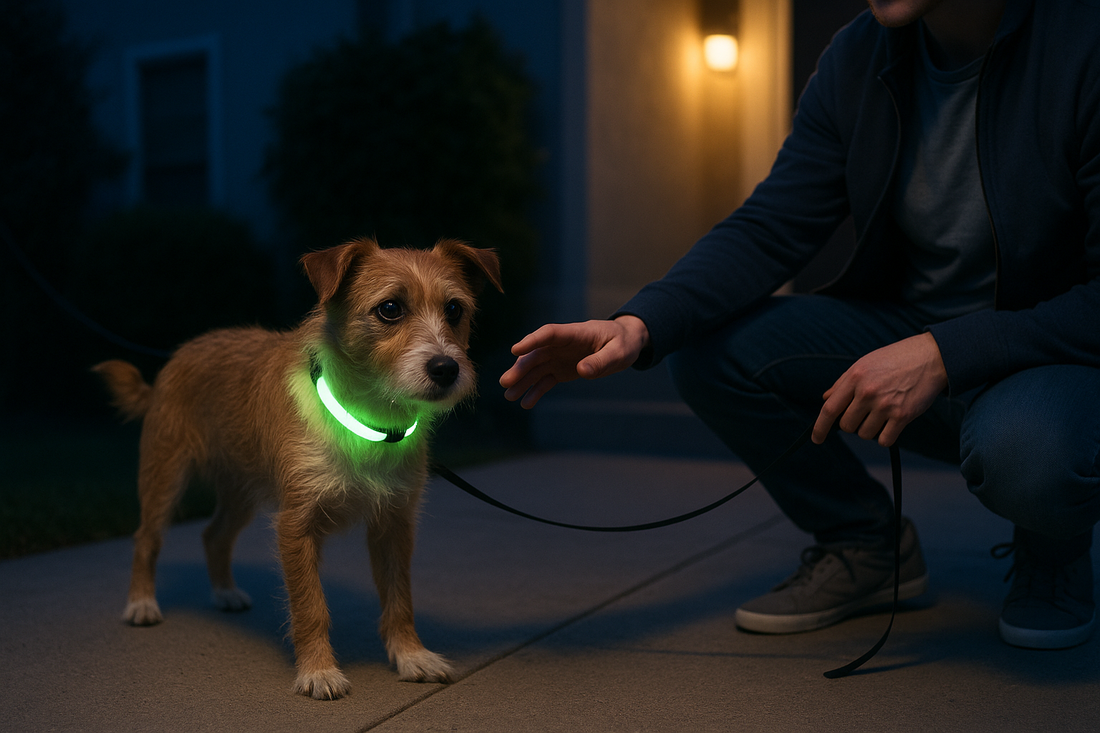
A bright LED dog collar for night walks helps here for two reasons. First, it makes the dog easier for others to see. Second, it gives you a clearer sense of where your dog is positioned when body language changes quickly. If your dog is already uneasy, you do not want low visibility making you tense too.
The night walk essentials collection is the most relevant collection for this topic because it supports calmer low-light routines instead of making you improvise every evening.
Start Smaller Than You Think
A lot of owners go too big too soon. They think, we have to finish the normal walk or the dog will never get used to it. Usually the opposite happens.
If your dog is scared of walking at night, start with a version that feels almost too easy. Maybe that means walking only to the gate and back for two nights. Maybe it means one short stretch of sidewalk under bright streetlights, then home. Maybe it means just standing outside for a minute, letting the dog sniff, rewarding calm behavior, and ending there.
Short success beats a longer messy walk every time. A spaniel that calmly handles three minutes tonight is more likely to handle five minutes in two days. A dog forced through a stressful 20-minute route may come out tomorrow even more resistant.
If you want the broader low-light safety side, our earlier article on what to check before walking a dog after dark pairs naturally with this one.
Build a Repeatable Confidence Pattern
Confidence grows when the dog starts predicting what happens next. Same door. Same first steps. Same calm route. Same reward for moving forward without tension.
This does not mean every night walk has to be identical forever. It means the early rebuilding phase should feel boring. Predictable is good here. A nervous dog is not looking for enrichment. A nervous dog is looking for evidence that the walk is manageable.
You can use food if your dog will take it outside. You can use praise if that works better. Some dogs settle fastest when they get a simple pattern: walk a few steps, pause, sniff, move again. Others need gentle forward motion and less stopping. Watch your own dog, not the ideal training script in your head.
And be honest about timing. If your dog gets more worried at 10 p.m. than at 7 p.m., use the easier window while you rebuild confidence.
What Not to Do With a Nervous Night Walker
Do not drag the dog forward
If the dog is freezing and leaning back, physical pressure usually confirms that the situation feels bad.
Do not add too much novelty
Nighttime is not the best moment to test a new route, new park, or busier street if the dog is already unsure.
Do not mistake shutdown for progress
A dog that goes quiet and mechanically walks beside you is not always over it. Sometimes that dog is just coping badly.
Do not make every night walk a training marathon
Sometimes a short toilet break and back inside is the right call. You can build confidence without turning every outing into a project.
Practical Steps for the Next 7 Walks
- Use the same easy route for several evenings in a row.
- Keep the walk shorter than your dog’s worry threshold, not longer.
- Reward calm movement, checking in with you, and relaxed sniffing.
- Choose brighter, quieter streets over the usual route if the usual route feels harder at night.
- Put visible gear on before the dog gets outside so the whole routine starts the same way.
- If your dog has one specific trigger, like parked cars or bins, create more distance instead of forcing close exposure too early.
If your dog needs a little decompression after a short night outing, having familiar indoor routines helps too. But the outdoor part should stay clear and manageable first.
How to Tell Confidence Is Actually Improving
You are not looking for a fearless dog overnight. You are looking for smaller signs.
The dog leaves the doorway more easily. The stop at the driveway gets shorter. Sniffing returns. The body loosens up earlier in the walk. Recovery after a surprising noise gets faster. These are real wins.
Many dogs do not go from nervous to bold in one clean line. Progress is often uneven. A windy night may look worse than yesterday. A busier street may still be too much. That is normal. What matters is whether the baseline is getting easier over a couple of weeks.
And if your dog’s anxiety is intense, worsening, or paired with panic behaviors, it may be time to work with a trainer or veterinarian instead of trying to solve it only through routine changes.

FAQ
Why is my dog only scared of walking at night and not during the day?
Night changes how your dog sees, hears, and interprets the environment. Familiar streets can feel uncertain once shadows, headlights, and nighttime sounds change the picture.
How long should a night walk be for a nervous dog?
Shorter than the point where your dog starts shutting down, freezing, or pulling to go home. For some dogs that may be three to five minutes at first.
Should I use treats if my dog is scared at night?
Yes, if your dog will eat outside. Calm food-taking can be a good sign that the dog is still able to process the environment without being overwhelmed.
Does an LED collar help a dog who is nervous at night?
It helps with visibility and can make the whole walk feel more controlled for you, which often improves handling. It will not fix fear by itself, but it supports a safer setup.
When should I stop trying to train through it and get help?
If your dog panics, refuses almost every night walk, startles severely, or seems to be getting worse rather than better, it is smart to bring in a trainer or vet.
Keep tonight’s walk shorter, brighter, and easier than yesterday’s. If you want a clearer low-light routine from the start, check how a dog LED collar fits into your regular evening setup →