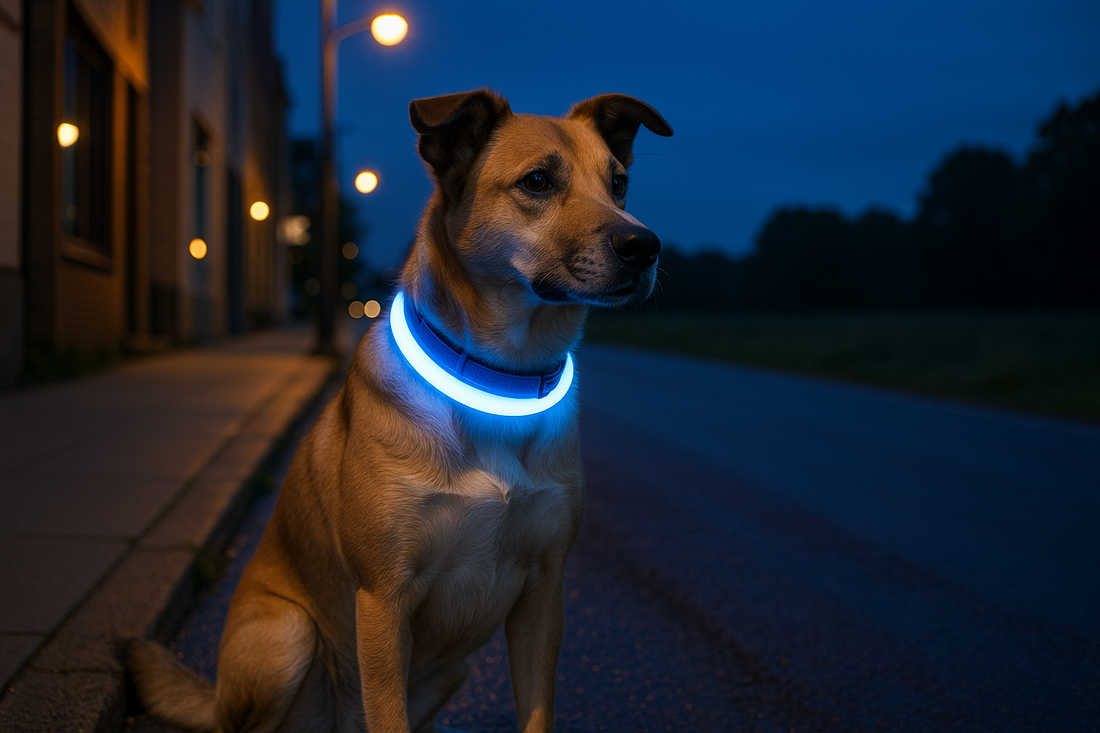
How Bright Should a Dog LED Collar Be for City Walks vs Rural Roads?
A collar that looks bright in your hallway can feel surprisingly weak once you step onto a dark road. That is why people ask how bright should dog led collar be and usually do not get a useful answer. Bright enough for a lit city block is not the same as bright enough for a rural lane with no sidewalk, no streetlights, and cars moving faster than you would like.
The right brightness depends on what your dog needs to stand out against. Urban glow, headlights, wet pavement, parked cars, hedges, open roads. A little dog in a well-lit neighborhood may only need moderate visible light to stay easy to track. A black shepherd near a dark roadside shoulder needs more obvious visibility from much farther away.

City Walks and Rural Roads Are Not the Same Problem
In a city, there is usually background light everywhere. Shop windows, traffic signals, apartment lobbies, car lights, and streetlamps all help outline movement. Your dog does not need to glow like a bicycle headlight. The collar just needs to stay clearly visible against that busy visual noise.
On rural roads, the issue flips. There may be almost no background light at all. A dog can vanish between passing headlights, especially if the coat is dark and the shoulder is narrow. A much brighter LED dog collar for low-light walks makes more sense there because drivers need to recognize the dog from farther away.
If your routine includes both environments, the safest setup is usually the one that can handle the darker one.
What Brightness Should Feel Like in the City
For city walks, the collar should be easy to pick up at a glance without feeling blinding up close. You are not trying to overpower streetlights. You are trying to keep the dog distinct in a busy visual environment.
A medium-bright collar usually works well for apartment neighborhoods, suburban sidewalks, and city blocks with regular lighting. You should be able to look ahead and track your dog’s position instantly near parked cars, intersections, and bike lanes.
If you walk mostly in better-lit areas, our earlier article on what to check before walking a dog after dark is a useful companion because route choice matters as much as gear brightness.
What Brightness Should Feel Like on Rural Roads
Rural roads need more from visibility gear. There is less ambient light, less margin for error, and often more speed from passing vehicles.
On darker roads, the collar should be visible well before headlights are close enough to fully light your dog. That is especially important for black dogs, smaller dogs, or dogs who drift toward the edge of the shoulder to sniff. If the collar only looks impressive when a car is already near you, it is not bright enough for that environment.
This is exactly why the night walk essentials collection fits this topic. It is not about style. It is about making the dog visible where ambient light is doing very little work for you.
Dog Size and Coat Color Change the Answer
A tiny Yorkie in a city crosswalk and a dark-coated Labrador on a country road need different visibility margins.
Small dogs
Small dogs benefit from stronger visibility than many owners expect because they sit lower against roads, curbs, and parked cars.
Dark-coated dogs
Black, dark brown, and brindle coats soak into low-light backgrounds quickly. These dogs usually benefit from brighter LED output even in places that feel moderately lit to you.
Fluffy or thick-coated dogs
If the fur partly hides the collar, brightness matters more. A collar can be technically bright and still not show well if only half of it is visible under the coat.
If thick fur is your main problem, the next relevant cluster topic will go deeper into choosing LED collars for dense coats.
Practical Brightness Checks You Can Do Tonight
- Step 20 to 30 meters away and see if your dog’s position is instantly obvious.
- Check the collar near parked cars, not only on an open sidewalk.
- Test it in the darkest part of your normal route, not just outside your front door.
- If your dog has a dark coat, view the collar from driver height across the road if possible.
- If you walk both city and rural routes, judge the collar by the harder route, not the easier one.
What Owners Usually Get Wrong
The usual mistake is assuming brighter is always automatically better in every context. In the city, a collar can be bright enough without being harsh or distracting up close. On a rural road, though, underpowered visibility is the bigger problem.
The second mistake is testing indoors. Indoor brightness tells you almost nothing useful about real road contrast. A collar needs to be judged against pavement, distance, and motion, not kitchen lighting.
If you are comparing visibility gear more broadly, our article on LED collar vs reflective vest for night dog walks helps explain why active light usually matters more than reflection in darker routes.

FAQ
How bright should a dog LED collar be for city walks?
Bright enough to make your dog instantly visible against streetlights, traffic, and parked cars without needing headlights to do the work.
Does a dog need a brighter LED collar on rural roads?
Usually yes. Rural roads have less ambient light, so the collar needs to stay visible from farther away.
Do black dogs need brighter LED collars?
In many cases, yes. Dark coats blend into low-light surroundings much faster than owners expect.
Can an LED collar be too dim even if it looks bright indoors?
Absolutely. Indoor brightness tests are misleading because they do not show how the collar performs on dark roads or from distance.
What is the best way to test dog collar brightness?
Test it outside, on your real route, from farther away than arm’s length, and ideally from across the road.
Test your current setup where your route is darkest, not where it is easiest. See how a dog LED collar performs on city sidewalks and darker roads before your next evening walk →